Page last updated on

Qwen3.8-2.4T-A95B
By Alibaba
The open-weight release of Qwen3.8-Max and the largest model in the Qwen family. It's the first Qwen model at Max scale to be opened. This checkpoint is text-only and always reasons (thinking can't be disabled).
Specifications
- Total parameters
- 2.4T (95B active)
- Active parameters
- 95B
- Architecture
- MoE
- Architecture class
- Qwen3_5MoeForCausalLM
- Attention
- Hybrid Gated DeltaNet + Gated Attention
- Context window
- 1M (262K native)
- Vocab size
- 248,320
- Precision
- BF16, FP8
- Modality
- Text in, Text out (open weights). Vision via API only
- License
- Qwen3.8-Max License
- Released
- August 2026
- Recommended hardware
- 8× B300 (NVFP4)8× MI355X (MXFP4)
- Best for
- Long-horizon autonomous coding, professional work agents, and research
Good to know
-
The open checkpoint is not exactly the same as the Qwen3.8-Max API model. Qwen3.8-2.4T-A95B is text-only, and thinking can't be turned off: every response opens with a <think> block. The QwenCloud version of Qwen3.8-Max adds vision input, a non-thinking mode, 1M context by default, and built-in tools. The open weights ship with 262,144 tokens of native context, extensible to 1,010,000.
-
The license is not MIT or Apache. The Qwen3.8-Max License allows commercial use, modification, and redistribution, but a Model as a Service or AI Work Assistant business above $50M of revenue in any twelve consecutive months must obtain a separate license from Qwen. Products above 100M monthly active users or $20M of monthly revenue must display the model name prominently in the interface.
-
The companion open-weight model, Qwen3.8-27B, was published on August 14, 2026. It is the easier model to actually run, and it is more permissively licensed. Qwen3.8-27B is a 27B dense model under Apache 2.0, with native image and video understanding and 262,144 tokens of native context extensible to 1M. Quantized to 4 bits it fits a single 24GB consumer GPU. So the family now splits three ways: Qwen3.8-Max is the hosted system, Qwen3.8-2.4T-A95B is the text-only open checkpoint on this page, and Qwen3.8-27B is the small multimodal one.
Architecture
Qwen3.8-2.4T-A95B is a fine-grained Mixture-of-Experts model with 2.4 trillion total parameters. The config class is Qwen3_5MoeForCausalLM, so this is the Qwen3.5 lineage scaled up rather than a new family.
Three choices do the work:
- Hybrid attention. The
full_attention_intervalis 4. Three Gated DeltaNet linear-attention layers run before every full Gated Attention layer, which puts 69 linear layers against 23 full ones. Full attention uses 64 query heads and 4 KV heads at 256 dimensions per head. - Very sparse routing. 512 experts, an expert intermediate dimension of 2048, and 10 routed plus 1 shared expert per token. That activates roughly 4% of the network on any given token.
- Multi-token prediction. The config carries one MTP layer, used in pretraining and available for speculative decoding at serving time.
Serving is the hard part. BF16 weights run about 4.45 TiB, which means you need about three 8× B300 nodes or six 8× H200 nodes when considering overhead like the KV cache. The official FP8 checkpoint halves that to about 2.27 TiB, so two 8× B300 nodes. Fitting a single node means quantization below 8 bits: NVFP4 W4A4 at 1.32 TiB on 8× B300, or MXFP4 at 1.45 TiB on 8× MI355X.
For more models like this one, browse the full open source LLM directory, read the open source LLM ecosystem statistics, or see how a long context window is served in what is a KV cache.
Benchmarks
Alibaba published a full benchmark set against Claude Opus 4.8, Claude Fable 5, and GPT-5.6 Sol. Qwen3.8-Max leads the whole comparison group on PaperBench (93.0), IFBench (82.8), WideSearch (81.9), HealthBench (60.2), PLawBench (73.2), and PRBench-Finance (58.3). The weak spots are the hardest coding and reasoning tests: DeepSWE 1.1 (56.6), MLS-Bench-Lite (41.0), and HLE (43.6) all sit below the closed frontier.
Qwen3.8-Max vs frontier models
Scores published by Alibaba on the Qwen3.8-2.4T-A95B model card. Qwen3.8-Max runs at xhigh reasoning effort. The numbers describe the Qwen3.8-Max system, so the vision-dependent and 1M-context rows are not reproducible on the text-only open checkpoint.
Each model keeps the same color across every benchmark, stacked top to bottom in this order. Hover or focus a row to read all six scores.
Separate axis. Elo is not a percentage, so this row is plotted as points on a fitted scale starting at 1,400.
Separate axis. Elo is not a percentage, so this row is plotted as points on a fitted scale starting at 1,400.
- Opus 4.8
- Fable 5
- GPT-5.6 Sol max
- Qwen3.7-Max
- Qwen3.8-Max
View all scores as a table
| Benchmark | Opus 4.8 | Fable 5 | GPT-5.6 Sol max | Qwen3.7-Max | Qwen3.8-Max |
|---|---|---|---|---|---|
| Coding Agent | |||||
| Terminal Bench 2.1 | 84.6 | 84.6 | 88.8 | 74.5 | 86.6 |
| SWE-bench Pro | 69.2 | 80.0 | 64.6 | 60.6 | 67.7 |
| DeepSWE 1.1 | 59.0 | 70.0 | 73.0 | 21.6 | 56.6 |
| NL2Repo-Bench | 69.4 | n/a | n/a | 47.2 | 55.9 |
| FrontierSWE | 70.0 | 88.8 | n/a | 40.7 | 73.5 |
| MLS-Bench-Lite | 42.8 | 49.9 | 46.2 | 31.7 | 41.0 |
| PaperBench | 80.3 | 88.8 | 90.5 | 64.8 | 93.0 |
| AndroidBench | 69.8 | 84.5 | 74.0 | 56.5 | 75.1 |
| QwenSWEBench | 84.0 | 86.3 | 73.5 | 63.4 | 80.7 |
| QwenQoderBench | 62.7 | 63.1 | 53.8 | 36.8 | 58.4 |
| QwenReactBench (Elo) | 1,694 | 1,770 | 1,564 | 1,538 | 1,724 |
| QwenSVGBench (Elo) | 1,648 | 1,690 | 1,758 | 1,499 | 1,713 |
| General Agent | |||||
| CoWorkBench | 72.3 | 75.9 | 71.5 | 64.6 | 74.8 |
| WorkSpaceBench | 66.8 | 68.7 | 65.6 | 61.4 | 67.7 |
| JobBench | 48.4 | 57.4 | 45.4 | 31.3 | 53.4 |
| SkillsBench | 65.1 | 70.9 | 73.5 | 61.2 | 70.2 |
| Agents' Last Exam (Score) | 45.1 | n/a | 53.6 | 31.1 | 52.4 |
| Automation-Bench (Pass@1) | 27.2 | 29.1 | 29.7 | 14.2 | 27.3 |
| Toolathlon Verified (Pass@1) | 76.2 | 77.9 | 74.9 | 49.7 | 72.5 |
| WideSearch (Item-F1) | 72.9 | 81.2 | n/a | 75.2 | 81.9 |
| HLE w/ tools | 57.9 | 64.5 | 58.0 | 53.5 | 56.2 |
| General Capabilities | |||||
| GPQA Diamond | 92.0 | 92.6 | 94.1 | 92.4 | 92.6 |
| HLE | 45.7 | 53.3 | 47.2 | 41.4 | 43.6 |
| IFBench | 62.2 | 63.5 | 72.7 | 79.1 | 82.8 |
| $OneMillion-Bench (Expert score) | 41.8 | 55.9 | 53.8 | 44.4 | 52.5 |
| HealthBench | 52.4 | n/a | 55.3 | 54.5 | 60.2 |
| PLawBench | 69.6 | 70.2 | 72.3 | 58.9 | 73.2 |
| PRBench-Legal | 52.7 | 57.6 | 57.6 | 48.5 | 57.6 |
| PRBench-Finance | 51.9 | 55.8 | 55.5 | 46.8 | 58.3 |
| Long Context | |||||
| MRCR v2 256K (8-needle) | 83.2 | n/a | 93.8 | 86.7 | 92.9 |
| LongBench v2 | 69.1 | n/a | 67.1 | 65.3 | 66.3 |
Source: the Qwen3.8-Max model card. Best score in each row is marked.
Third-party evaluations
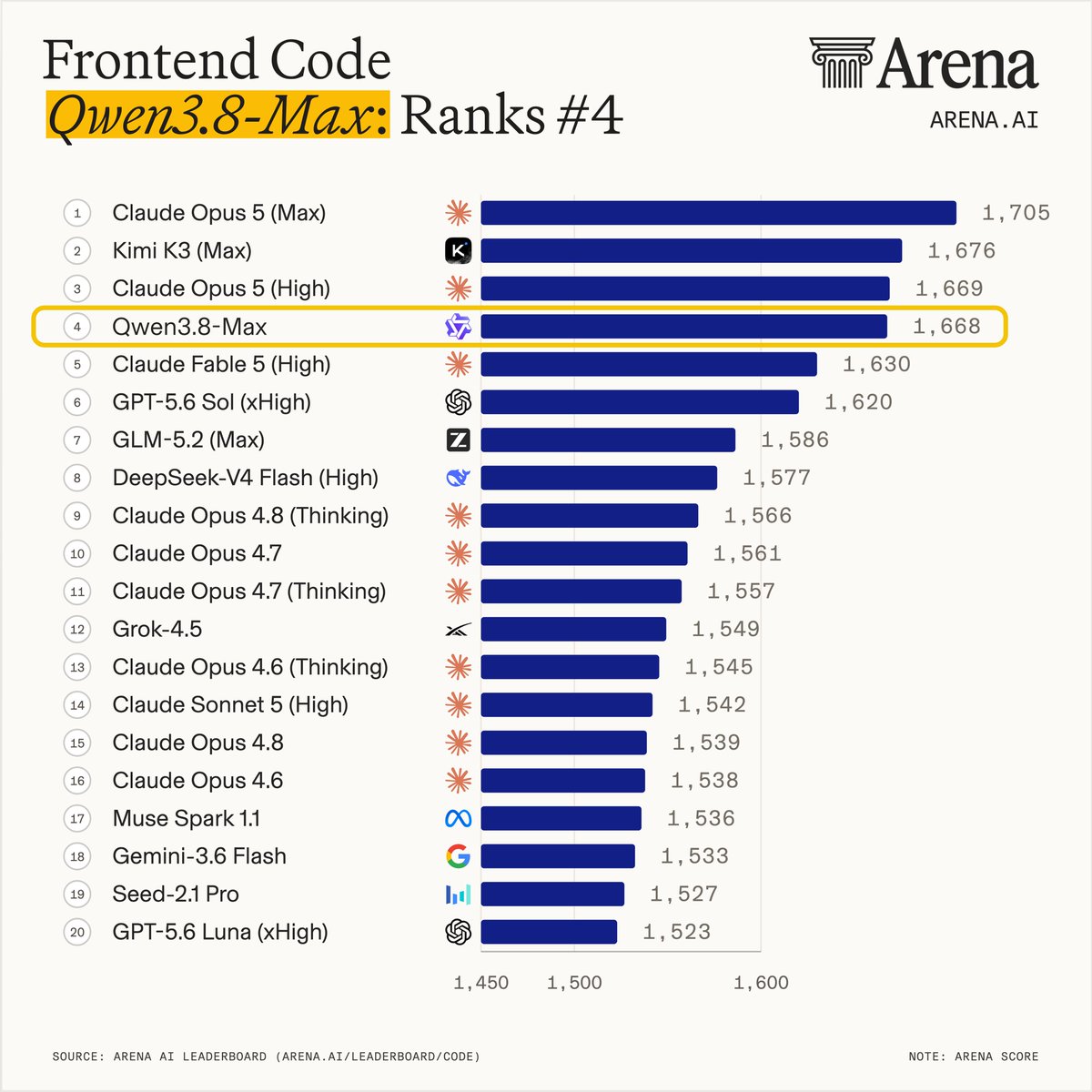
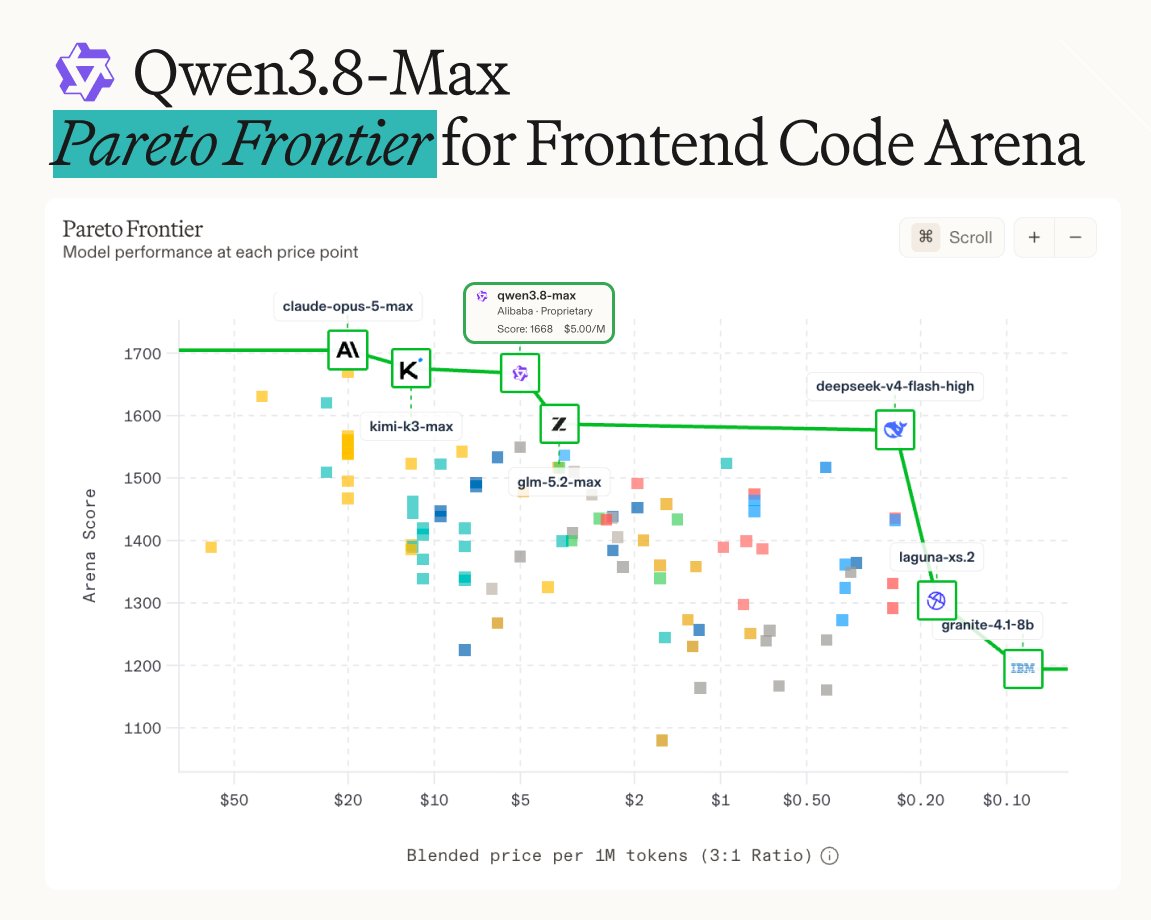
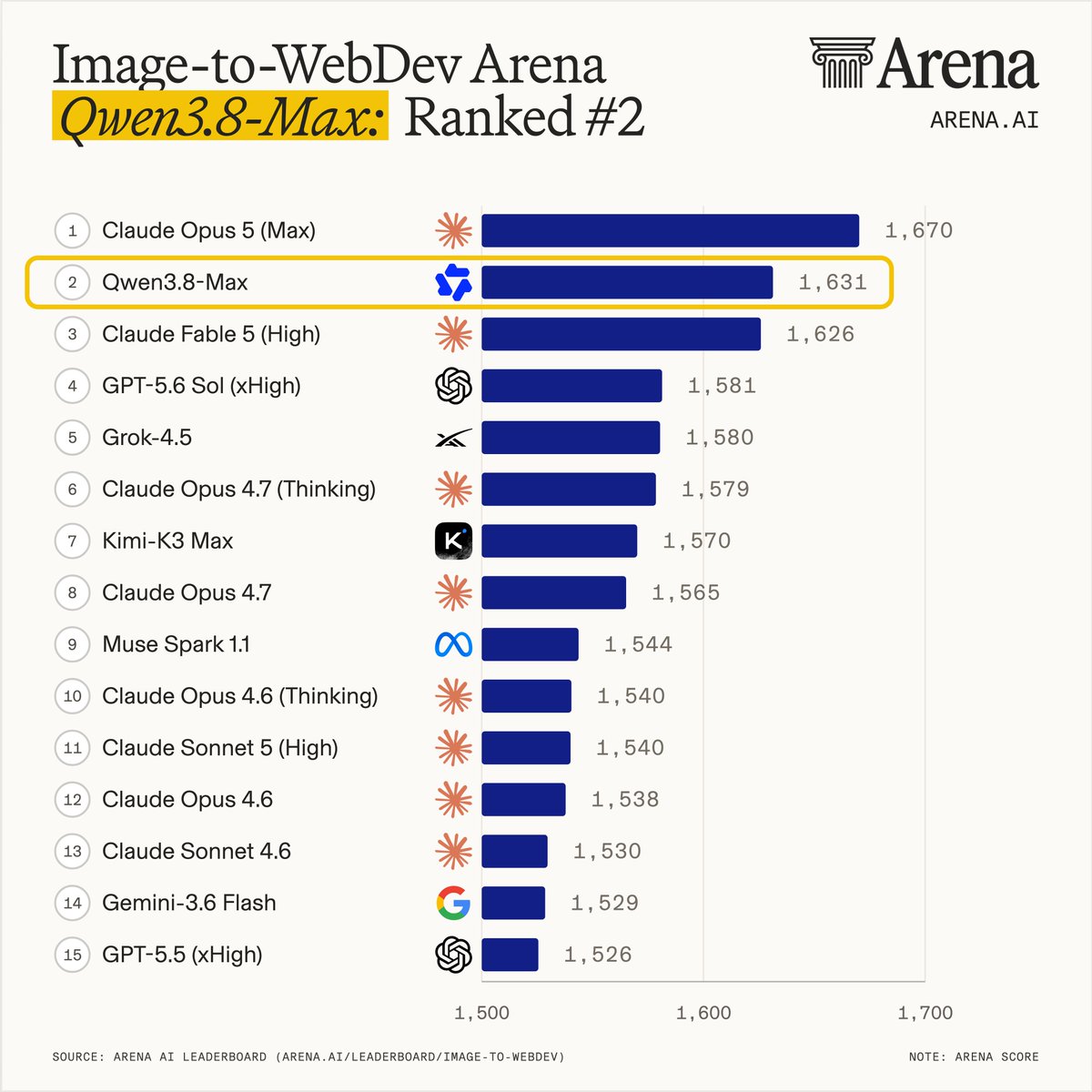
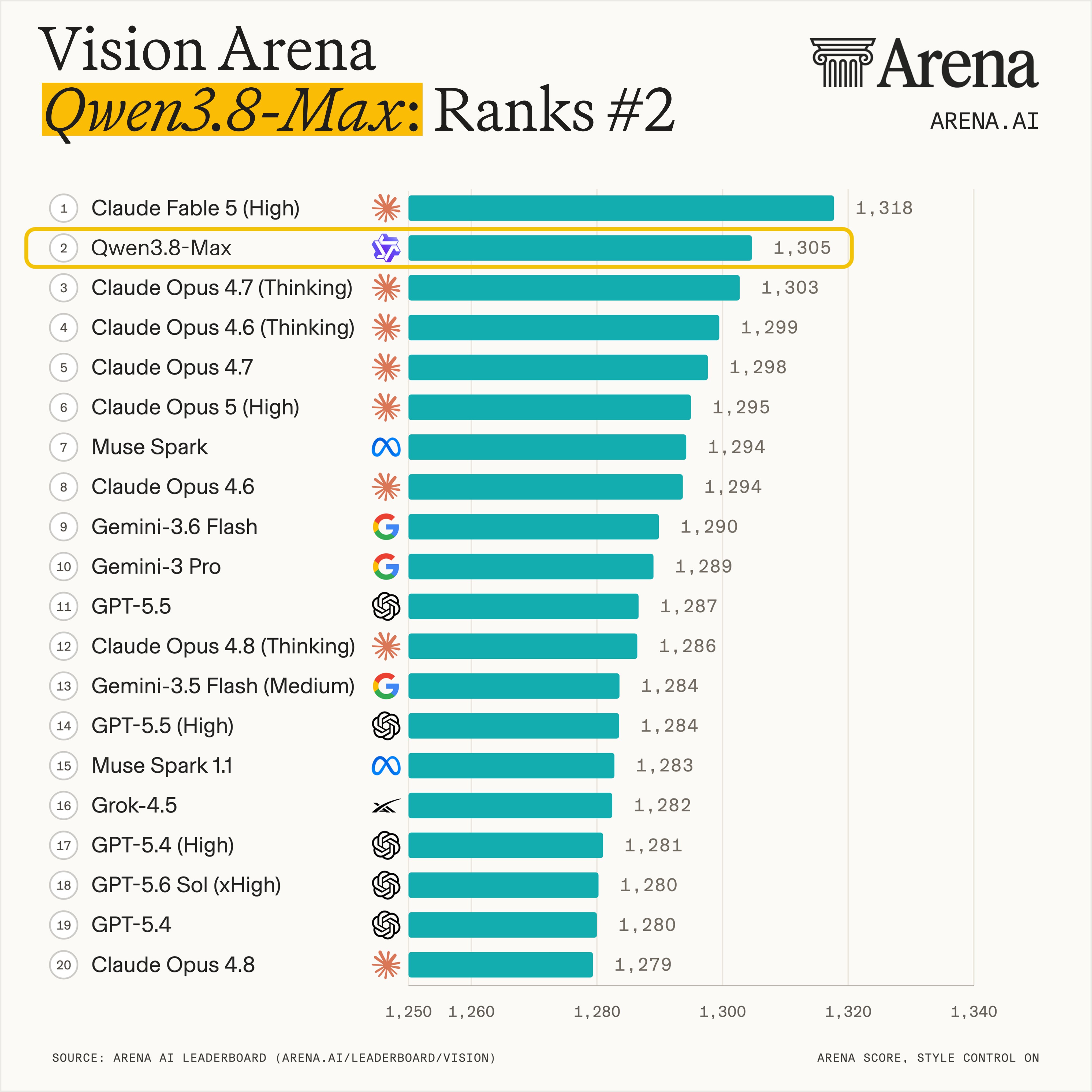
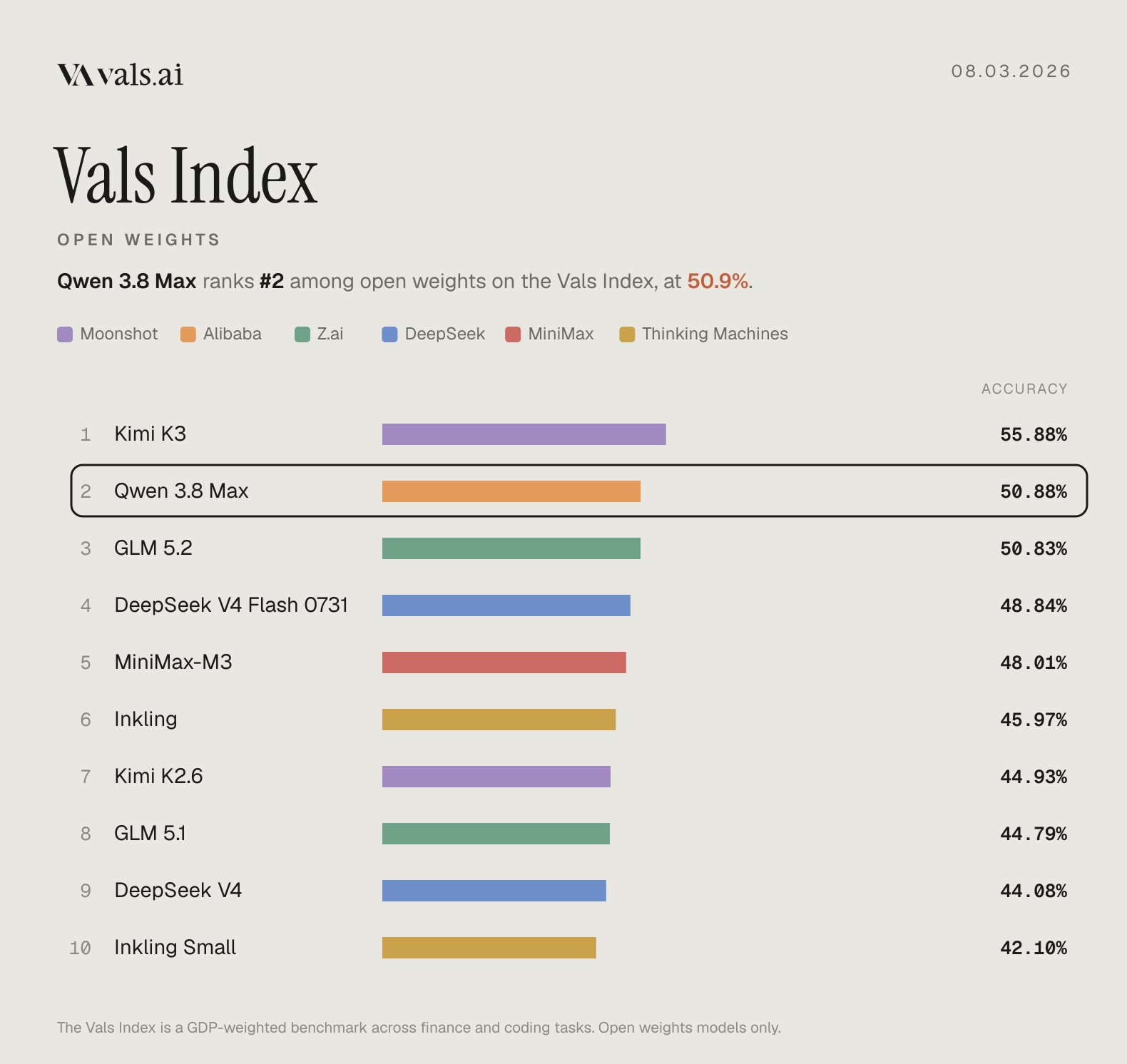
Independent leaderboards started scoring Qwen3.8-Max within a day of the API launch. The picture is consistent across coding, design, and vision boards: a top-three finish behind the Claude frontier models, at a much lower list price.
API pricing
Qwen3.8-Max is served through QwenCloud at $2.00 per million input tokens and $6.00 per million output tokens. One flat rate covers the whole 1M-token context window, so there is no long-prompt surcharge. Implicit cache reads drop input to $0.25 per million tokens, an 8x discount. Explicit caching costs $2.50 per million tokens to create and $0.17 per million tokens to read.
| Model | Input · cache hit | Input · cache miss | Output |
|---|---|---|---|
| Qwen3.8-Max | $0.25 | $2.00 | $6.00 |
Per 1M tokens, as of August 13, 2026. Official pricing.
That output price undercuts the closed frontier by a wide margin. Claude Opus 5 costs $25 per million output tokens, so Qwen3.8-Max is roughly 76% cheaper. Claude Fable 5 costs $50, an 88% gap. GPT-5.6 Sol costs $20 after the OpenAI price cut of August 21, 2026, a 70% gap, and charges $30 per million output tokens once a request crosses into the long-context tier. The Arena Pareto chart puts the model on the price-performance frontier at $5.00 per million blended tokens.
Sources: QwenCloud pricing · Claude pricing · OpenAI pricing
What people are saying
“You made a post on X without giving any hint that the released model weights wouldn't actually be the full Qwen 3.8 Max.”
NodeLinker
Hugging Face Aug 12, 2026
“We ran a test between the new Qwen3.8-Max, Opus 5 and GPT-5.6 Sol. 3 models. same prompt. one-shot with the /design command. Reviewed gameplay features, UX/UI and cost. 🔹 Qwen3.8-Max → 9/10 · $0.0248 🔹 GPT-5.6 Sol → 9/10 · $0.150 🔹 Opus 5 → 8.5/10 · $0.253 Qwen3.8-Max is approximately 4.2× cheaper than GPT-5.6, Sol, Opus 5 and has the same level of UI, UX, and gameplay.”
Command Code
@CommandCodeAI
X Aug 3, 2026
“Qwen3.8-Max is the best object detection VLM - satellite images - infrared images - documents - techical drawings - hand-sketched diagrams - crowded scenes - small objects”
SkalskiP
@skalskip92
X Aug 3, 2026
“We ran Qwen3.8-Max on our cybersecurity benchmark. Given enough attempts, it found more CVEs than most frontier models, tying Opus 5 for first place... Across the three runs, Qwen found 26 of 32 CVEs, reaching 81.25% pass@3 recall, outperforming GPT-5.6-Sol and matching Opus 5 at a lower price... Qwen is very inconsistent, but can be very strong if run multiple times.”
pilvar (Philippe Dourassov)
@pilvar222 · Aikido Security
X Aug 4, 2026
“It looks like Qwen3.8-Max has a major overthinking problem, it uses a LOT of tokens and is very slow, period, no other way to see it. My cost to run this benchmark was $126.25, to run the exact same eval suite with DeepSeek V4-Flash was only $13.60. This makes Qwen3.8-Max an insanely expensive model.”
Morgan
@morganlinton
X Aug 4, 2026
“You made a post on X without giving any hint that the released model weights wouldn't actually be the full Qwen 3.8 Max.”
NodeLinker
Hugging Face Aug 12, 2026
“We ran a test between the new Qwen3.8-Max, Opus 5 and GPT-5.6 Sol. 3 models. same prompt. one-shot with the /design command. Reviewed gameplay features, UX/UI and cost. 🔹 Qwen3.8-Max → 9/10 · $0.0248 🔹 GPT-5.6 Sol → 9/10 · $0.150 🔹 Opus 5 → 8.5/10 · $0.253 Qwen3.8-Max is approximately 4.2× cheaper than GPT-5.6, Sol, Opus 5 and has the same level of UI, UX, and gameplay.”
Command Code
@CommandCodeAI
X Aug 3, 2026
“Qwen3.8-Max is the best object detection VLM - satellite images - infrared images - documents - techical drawings - hand-sketched diagrams - crowded scenes - small objects”
SkalskiP
@skalskip92
X Aug 3, 2026
“We ran Qwen3.8-Max on our cybersecurity benchmark. Given enough attempts, it found more CVEs than most frontier models, tying Opus 5 for first place... Across the three runs, Qwen found 26 of 32 CVEs, reaching 81.25% pass@3 recall, outperforming GPT-5.6-Sol and matching Opus 5 at a lower price... Qwen is very inconsistent, but can be very strong if run multiple times.”
pilvar (Philippe Dourassov)
@pilvar222 · Aikido Security
X Aug 4, 2026
“It looks like Qwen3.8-Max has a major overthinking problem, it uses a LOT of tokens and is very slow, period, no other way to see it. My cost to run this benchmark was $126.25, to run the exact same eval suite with DeepSeek V4-Flash was only $13.60. This makes Qwen3.8-Max an insanely expensive model.”
Morgan
@morganlinton
X Aug 4, 2026
Run it yourself

vllm serve Qwen/Qwen3.8-2.4T-A95B
sglang serve --model-path Qwen/Qwen3.8-2.4T-A95BFrequently asked questions
Is Qwen3.8-2.4T-A95B open source?
The weights are open. Alibaba published Qwen3.8-2.4T-A95B on Hugging Face on August 12, 2026 under the custom Qwen3.8-Max License. That license permits commercial use, fine-tuning, and redistribution, but a Model as a Service or AI Work Assistant business earning more than $50 million in any twelve consecutive months must obtain a separate license from Qwen. An official FP8 checkpoint ships alongside the BF16 weights.
What is the difference between Qwen3.8-Max and Qwen3.8-2.4T-A95B?
Qwen3.8-Max is the hosted model on QwenCloud. Qwen3.8-2.4T-A95B is the open-weight checkpoint behind it. The architecture is the same 2.4T Mixture-of-Experts stack, but the hosted version carries more things the download does not: vision input, a non-thinking mode, a 1M-token context window by default, and built-in tools. The open weights are text-only, always reason, and ship with 262,144 tokens of native context, extensible to 1,010,000. The benchmark scores Alibaba published describe the Qwen3.8-Max system, so the vision and 1M-context rows are not reproducible on the download.
How big is Qwen3.8-2.4T-A95B?
Qwen3.8-2.4T-A95B has 2.4 trillion total parameters and activates 95 billion per token. The Mixture-of-Experts stack has 92 layers, a hidden dimension of 8192, and 512 experts, of which 10 routed plus 1 shared fire per token. The vocabulary is 248,320 tokens and the released weights are BF16, about 4.45 TiB, or 2.27 TiB in FP8.
How much does the Qwen3.8-2.4T-A95B API cost?
The weights are free to download, and QwenCloud serves them as Qwen3.8-Max for $2.00 per million input tokens and $6.00 per million output tokens. One flat rate covers the whole context window, so there is no long-prompt surcharge. Implicit cache reads drop input to $0.25 per million tokens. Explicit cache creation costs $2.50 per million tokens and explicit cache reads cost $0.17 per million tokens. For comparison, Claude Opus 5 costs $25 per million output tokens and GPT-5.6 Sol costs $20.
How does Qwen3.8-2.4T-A95B compare to Claude Fable 5 and GPT-5.6 Sol?
It trades wins with both. Alibaba published the comparison for Qwen3.8-Max, the hosted version of these weights. Qwen3.8-Max leads the group on PaperBench at 93.0, IFBench at 82.8, WideSearch at 81.9, and PLawBench at 73.2. GPT-5.6 Sol leads Terminal Bench 2.1 at 88.8 against 86.6, and Claude Fable 5 leads SWE-bench Pro at 80.0 against 67.7 and FrontierSWE at 88.8 against 73.5. The list price gap is large: $6 per million output tokens against $20 for GPT-5.6 Sol and $50 for Claude Fable 5.