Page last updated on

GLM-5.3
By Zhipu AI
The Z.ai coding flagship, rebuilt through post-training alone on the same 753B base as GLM-5.2. Open-source SOTA on Terminal Bench 3.0 and state of the art on CyberGym.
Specifications
- Total parameters
- 753B (40B active)
- Active parameters
- 40B
- Architecture
- MoE
- Architecture class
- GlmMoeDsaForCausalLM
- Context window
- 1M
- Vocab size
- 154,880
- Precision
- FP8
- Modality
- Text
- License
- GLM-5.3 License
- Released
- August 2026
- Recommended hardware
- 8× H2008× B2008× MI355X
- Best for
- Agentic coding, long-horizon engineering tasks, and vulnerability research
Good to know
-
The custom GLM-5.3 License grants the same permissions MIT does, covering commercial use, fine-tuning, redistribution, and derivative works. One clause is new. An operator of a Model as a Service business whose group revenue tops 10 billion US dollars over any 12 consecutive months must pass a Z.ai security review before any commercial use.
-
Thinking cannot be disabled. GLM-5.3 takes a `reasoning_effort` of low, high, or max. Any other value falls back to max, which is the default and the setting behind every published benchmark. The chat template defaults `clear_thinking` to false, so pass `clear_thinking=true` explicitly for chat use.
-
Z.ai reports that GLM-5.3 found 2,436 vulnerabilities across 269 open source projects when run against real codebases with security teams in China, including 1,097 rated medium to high. As of the announcement, 53 were publicly disclosed and 2,383 remained under embargo. The oldest flaw dated to 1981, and the average vulnerability had survived 26.6 years before discovery. Z.ai tracks the disclosure process in a public ledger.
Architecture
GLM-5.3 is a deliberate controlled experiment. Z.ai kept the base model, the architecture, and both parameter counts identical to GLM-5.2, then spent a month scaling post-training alone.
The stack underneath is the one GLM-5.2 introduced. The config declares GlmMoeDsaForCausalLM: 78 layers, 256 routed experts plus 1 shared expert, 8 experts active per token, and a hidden size of 6,144. IndexShare handles long-context efficiency by reusing one sparse-attention indexer across each group of four layers, selecting the top 2,048 tokens per query, which keeps the KV cache affordable at 1M tokens. SAO carries the reinforcement learning on long-horizon tasks. Training runs on slime, the open source RL framework from Z.ai, with Megatron on the training side and SGLang on rollout.
What changed is scale and plumbing:
- More environments, not more parameters. Z.ai built pipelines that synthesize long-horizon task environments end to end, along with the reward signal for a subset. A judge agent attempts each task to confirm it is solvable, and verifiers are written without access to the reference solution.
- A faster training loop. Workload-aware scheduling and a local-storage caching layer lifted end-to-end RL throughput by more than 2.3x on long-horizon coding tasks. Training and rollout log probabilities were aligned to the 1e-7 level.
- Fewer tokens per task. The efficiency gain is the underrated part. At max effort GLM-5.3 reaches 34.5% on the in-house Z.ai Code Bench using about 75K output tokens per task, where GLM-5.2 needed 96K to reach 23.4%.
The released checkpoint is FP8 throughout, E4M3 with 128x128 block scaling, spread across 141 safetensors shards for roughly 756GB. Z.ai shipped no BF16 version, so quantization is part of the release rather than something the community adds later. At about one byte per parameter the weights land on a single 8-GPU node, which is what makes a 753B model practical to self-host at all.
For more models like this one, browse the full open source LLM directory, compare the field in the best open source LLMs in 2026, or read the open source LLM ecosystem statistics.
Benchmarks
GLM-5.3 is the same base model as GLM-5.2 with a month of extra post-training on top, so the honest comparison is the GLM-5.2 column.
GLM-5.3 vs frontier models
Scores published by Z.ai on the GLM-5.3 model card. Higher is better on every row. Scores marked n/a were not reported.
Each model keeps the same color across every benchmark, stacked top to bottom in this order. Hover or focus a row to read all six scores.
Separate axis. Tasks is not a percentage, so this row is plotted as points on a fitted scale starting at -100.
Separate axis. Tasks is not a percentage, so this row is plotted as points on a fitted scale starting at -200.
Separate axis. Elo is not a percentage, so this row is plotted as points on a fitted scale starting at 1,400.
- GLM-5.2
- Kimi K3
- DS-V4-Pro-0813
- Qwen3.8-Max
- Opus 4.8
- Fable 5
- GPT-5.6 Sol
- GLM-5.3
View all scores as a table
| Benchmark | GLM-5.2 | Kimi K3 | DS-V4-Pro-0813 | Qwen3.8-Max | Opus 4.8 | Fable 5 | GPT-5.6 Sol | GLM-5.3 |
|---|---|---|---|---|---|---|---|---|
| Coding | ||||||||
| Terminal Bench 2.1 | 81.0 | 88.3 | 87.9 | 86.6 | 85.0 | 88.0 | 88.8 | 88.2 |
| Terminal Bench 3.0 | 4.6 | 17.4 | n/a | n/a | 21.1 | 33.7 | 34.6 | 28.3 |
| DeepSWE v1.1 | 46.2 | 67.5 | 62.7 | 56.6 | 58.0 | 69.7 | 72.7 | 66.9 |
| NL2Repo | 48.9 | 58.0 | 61.1 | 55.9 | 69.7 | n/a | n/a | 58.0 |
| ProgramBench (Almost Solved) | 9.5 | 17.5 | n/a | 10.5 | 15.5 | 33.0 | 23.0 | 19.0 |
| FrontierSWE | 67.5 | n/a | n/a | n/a | 66.5 | 88.2 | n/a | 78.1 |
| SWE-Marathon v1.1 | 19.4 | 48.1 | n/a | n/a | 48.8 | 33.1 | 42.5 | 42.5 |
| PostTrainBench | 31.7 | 32.0 | n/a | n/a | 32.9 | 41.8 | 36.2 | 39.8 |
| Cyber | ||||||||
| CyberGym | 77.2 | 80.0 | 83.3 | 78.5 | 78.1 | 83.8 | 83.6 | 84.5 |
| ExploitBench | 24.4 | 32.2 | n/a | 28.8 | 40.0 | 78.0 | 76.5 | 54.4 |
| ExploitGym 2h (Tasks) | 29 | 36 | n/a | 14 | 80 | 181 | 216 | 105 |
| ExploitGym 6h (Tasks) | 39 | 70 | n/a | 26 | 120 | 247 | 293 | 130 |
| Agentic | ||||||||
| Toolathlon Verified | 59.9 | 76.5 | 74.1 | 72.5 | 76.2 | 74.7 | 74.9 | 73.0 |
| AutomationBench v1.0.6 | 26.2 | 46.7 | 43.2 | 39.8 | 41.0 | 46.2 | 45.8 | 48.2 |
| Agents' Last Exam (ALE-CLI) | 23.8 | 27.6 | 25.7 | 27.0 | 25.7 | 23.8 | 28.6 | 28.5 |
| HLE w/ Tools | 54.7 | 59.8 | 60.0 | 56.2 | 57.9 | 63.9 | 64.5 | 62.5 |
| GDPval-AA v2 (Elo) | 1,508 | 1,682 | 1,590 | 1,739 | 1,588 | 1,743 | 1,730 | 1,769 |
Source: the GLM-5.3 model card. Best score in each row is marked.
Third-party evaluations
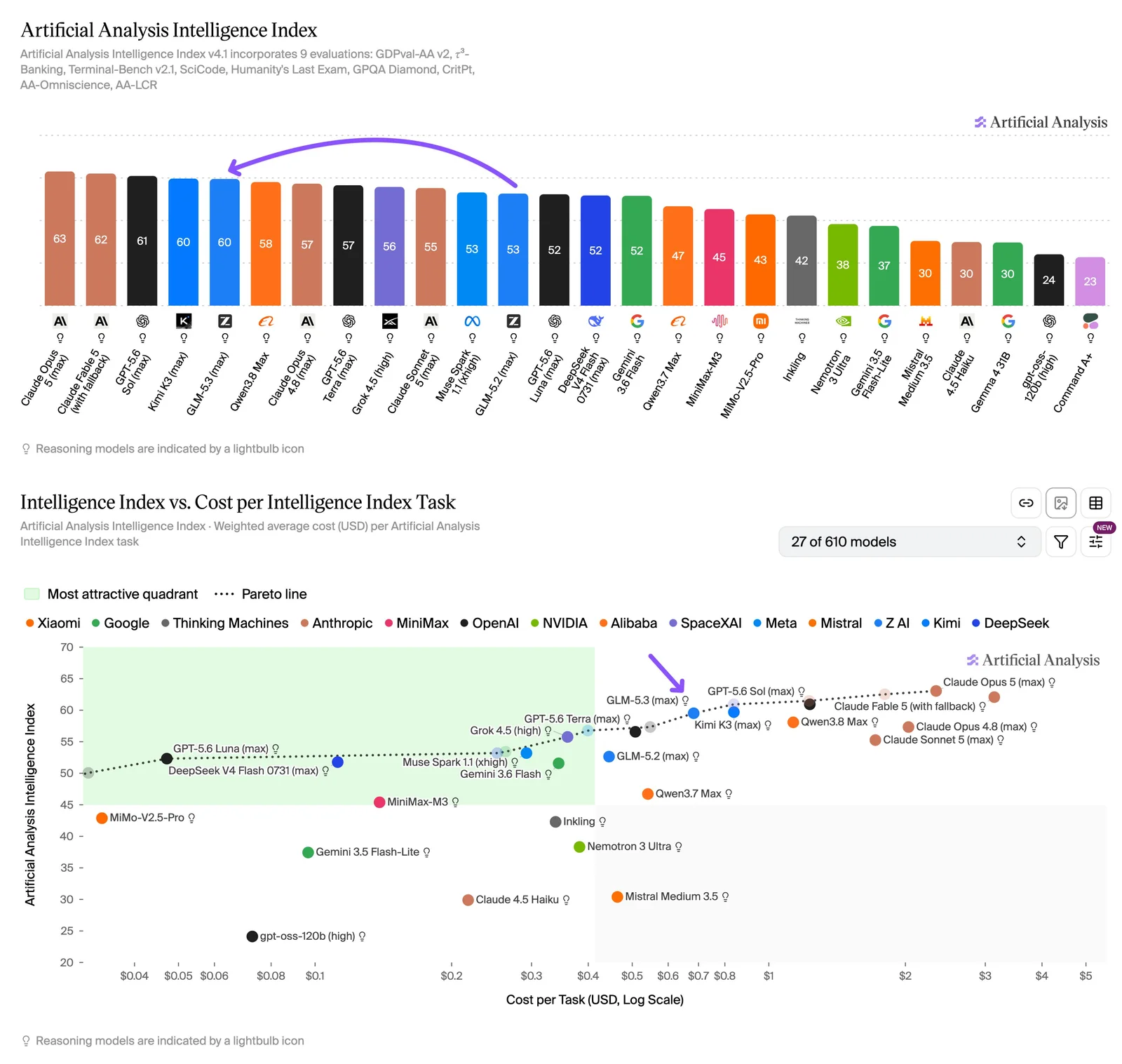
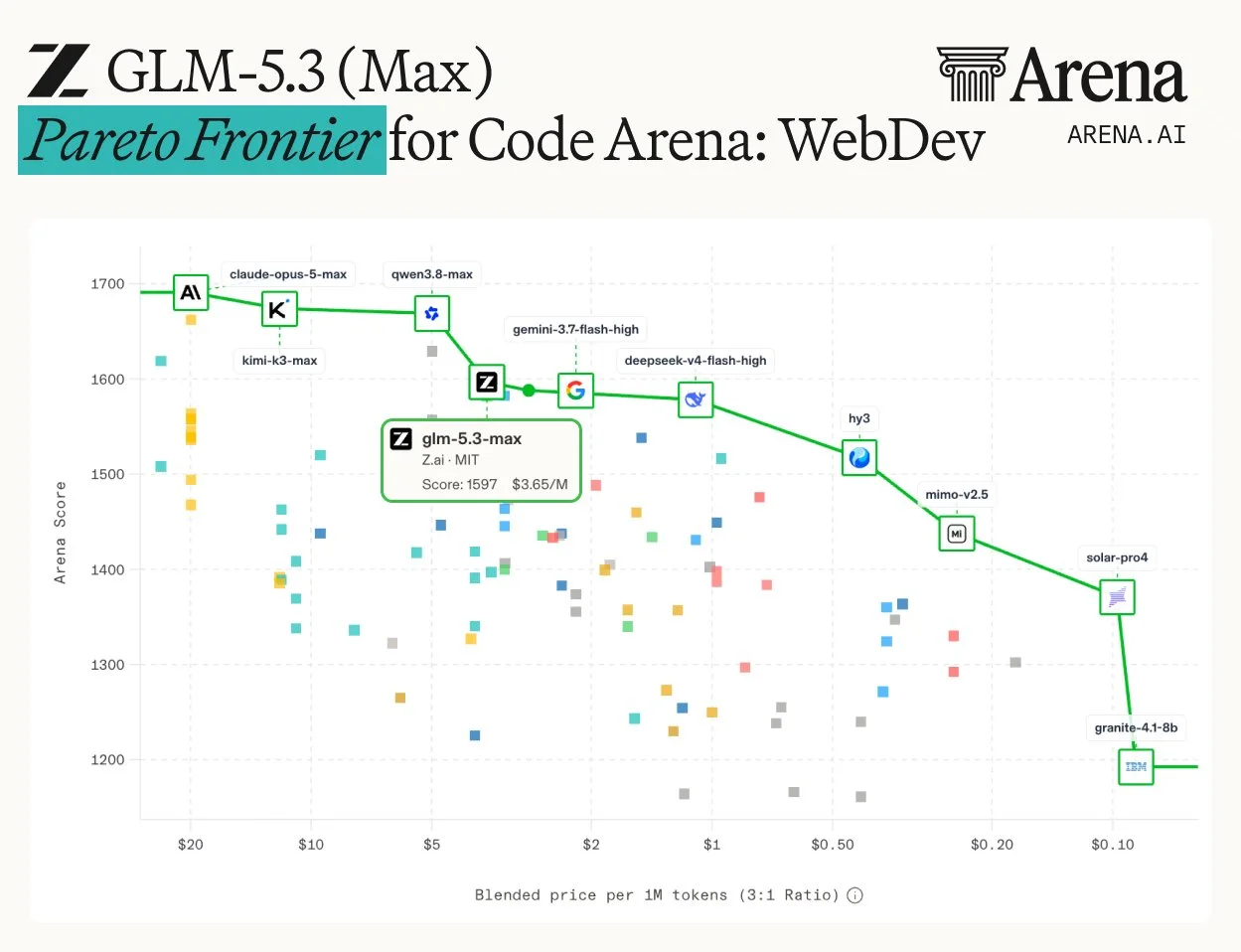
Independent scoring landed during the two weeks when GLM-5.3 was API-only, so the numbers below describe the hosted endpoint rather than a self-hosted checkpoint. Both agree on the shape of the result: GLM-5.3 moved up a tier from GLM-5.2 and now sits level with the strongest open-weight competition.
API pricing
GLM-5.3 ships at the same API rates as GLM-5.2: $1.40 per million input tokens, $0.26 per million cached input tokens, and $4.40 per million output tokens. A capability jump at a flat price is the headline here. Z.ai lists cached input storage as free for a limited time. Since August 28, 2026 the API is no longer the only route, because the open weights make self-hosting a real alternative for anyone with an 8-GPU node.
| Model | Input · cache hit | Input · cache miss | Output |
|---|---|---|---|
| GLM-5.3 | $0.26 | $1.40 | $4.40 |
| GLM-5.2 | $0.26 | $1.40 | $4.40 |
Per 1M tokens, as of September 3, 2026. Official pricing.
Against the closed frontier the gap is wide. Claude Opus 5 costs $25 per million output tokens, so GLM-5.3 is about 82% cheaper. GPT-5.6 Sol costs $20 after the OpenAI price cut of August 21, 2026, a roughly 78% gap. The comparison that matters more is token efficiency, because GLM-5.3 spends fewer tokens to get further. On the in-house Z.ai Code Bench, the model reaches 34.5% at around 75K output tokens per task at max effort, against 23.4% at 96K for GLM-5.2. At high effort it reaches 31.4% at about 50K output tokens, above Claude Opus 4.8 at 29.5% with 120K. Claude Fable 5 still leads outright at 39.5%.
Most API users will reach GLM-5.3 through the GLM Coding Plan rather than per-token billing. That plan moved to a points quota, counted separately for input, cached input, and output. Calls outside peak hours consume half the standard points. Peak is 14:00 to 18:00 UTC+8, Monday through Friday, so every other hour including the whole weekend gets the off-peak rate.
Sources: Z.ai pricing · GLM-5.3 model card · GLM-5.3 announcement · Claude pricing · OpenAI pricing
What people are saying
“GLM-5.3 is our controlled experiment on that claim. Same base, same architecture, same total and activated parameters as GLM-5.2. One month of scaling long-horizon environments and RL. The gains are not marginal... What this experiment taught us is that the dials do not have to be turned together, and that the one worth turning next is rarely the one that was worth turning last. We are not done scaling.”
Jie Tang
@jietang · Founder and chief scientist, Zhipu AI
X Aug 19, 2026
“GLM 5.3 is finally here I had the chance to test it 24 hours before its official release, and what I noticed > it stays on track longer > handles complex coding tasks with fewer corrections > feels noticeably more reliable across multi step workflows..”
JUMPERZ
@jumperz
X Aug 14, 2026
“GLM 5.3 is actually a huge deal. They didn't make the underlying model bigger or fundamentally change the architecture. They just took GLM 5.2 and post trained it harder. Yet, that alone produced major gains, especially in complex coding, long-horizon agent tasks, and...”
AI Search
@aisearchio
X Aug 14, 2026
“GLM-5.3 is the most capable open-weights model for coding.”
Command Code
@CommandCodeAI
X Aug 14, 2026
“GLM-5.3 is our controlled experiment on that claim. Same base, same architecture, same total and activated parameters as GLM-5.2. One month of scaling long-horizon environments and RL. The gains are not marginal... What this experiment taught us is that the dials do not have to be turned together, and that the one worth turning next is rarely the one that was worth turning last. We are not done scaling.”
Jie Tang
@jietang · Founder and chief scientist, Zhipu AI
X Aug 19, 2026
“GLM 5.3 is finally here I had the chance to test it 24 hours before its official release, and what I noticed > it stays on track longer > handles complex coding tasks with fewer corrections > feels noticeably more reliable across multi step workflows..”
JUMPERZ
@jumperz
X Aug 14, 2026
“GLM 5.3 is actually a huge deal. They didn't make the underlying model bigger or fundamentally change the architecture. They just took GLM 5.2 and post trained it harder. Yet, that alone produced major gains, especially in complex coding, long-horizon agent tasks, and...”
AI Search
@aisearchio
X Aug 14, 2026
“GLM-5.3 is the most capable open-weights model for coding.”
Command Code
@CommandCodeAI
X Aug 14, 2026
Run it yourself

vllm serve zai-org/GLM-5.3
sglang serve --model-path zai-org/GLM-5.3Frequently asked questions
Is GLM-5.3 open source?
Yes. Z.ai published the GLM-5.3 weights to Hugging Face on August 28, 2026, two weeks after the API launch on August 14. The repository is ungated, so no access request is needed. The license is not MIT this time. GLM-5.3 uses a custom GLM-5.3 License that grants the same permissions MIT does, including commercial use, fine-tuning, and redistribution, with one added condition: a Model as a Service operator whose group revenue exceeds 10 billion US dollars over any 12 consecutive months must pass a Z.ai security review first.
What is the difference between GLM-5.3 and GLM-5.2?
Only the post-training. Z.ai states that GLM-5.3 uses the same base model as GLM-5.2, so the 753 billion total parameters, roughly 40 billion activated per token, and the 1M token context window are unchanged. One extra month of scaling long-horizon RL environments produced the gains: Terminal Bench 3.0 from 4.6 to 28.3, DeepSWE v1.1 from 46.2 to 66.9, CyberGym from 77.2 to 84.5, and ExploitBench from 24.4 to 54.4.
How much does the GLM-5.3 API cost?
GLM-5.3 costs $1.40 per million input tokens, $0.26 per million cached input tokens, and $4.40 per million output tokens, the same rates as GLM-5.2. Through the GLM Coding Plan the model is billed on a points quota instead, with calls outside 14:00 to 18:00 UTC+8 on weekdays consuming half the standard points. Self-hosting the open weights is now the third option.
How does GLM-5.3 compare to Kimi K3, Claude Fable 5, and GPT-5.6 Sol?
It trades wins and is close on the headline coding test. Z.ai reports 88.2 on Terminal Bench 2.1 against 88.3 for Kimi K3, 88.0 for Fable 5, and 88.8 for GPT-5.6 Sol. GLM-5.3 leads CyberGym at 84.5 against 83.8 and 83.6, and tops GDPval-AA v2 at 1769. The closed models keep clear leads on the harder tests: Terminal Bench 3.0 is 28.3 against 33.7 for Fable 5 and 34.6 for GPT-5.6 Sol, and ExploitBench is 54.4 against 78.0 and 76.5.
What hardware do I need to run GLM-5.3?
One 8-GPU node. The weights ship only in FP8, which fit on 8x H200, 8x B200, or 8x MI355X with room left for the KV cache. Z.ai published no BF16 checkpoint, so there is no larger variant to fall back to. vLLM and SGLang both carry official GLM-5.3 recipes, and TokenSpeed, Transformers, KTransformers, and Unsloth are supported too. Ascend NPU users can serve it through vLLM-Ascend, xLLM, or SGLang.