Is DeepSeek Better Than ChatGPT? 25+ DeepSeek Stats (2026)
Explore 25+ DeepSeek statistics for 2026, including downloads, users, usage, training cost, API pricing, funding, and ChatGPT comparisons.

Written by Sherlock Xu
Last updated on Aug. 17, 2026
Is DeepSeek better than ChatGPT? For cost, open weights, and self-hosting, DeepSeek often has the stronger argument. For total consumer reach, revenue, and ecosystem breadth, ChatGPT still leads.
That tradeoff explains why DeepSeek became such a big story. In January 2025, a Chinese AI lab turned an open source reasoning model into the No. 1 free app on the U.S. App Store. A few days later, NVIDIA lost almost $600 billion in market value in one day as investors rethought the cost curve of frontier AI.
This blog post collects the most useful DeepSeek statistics for 2026, with each major number tied to the closest public source.
Top DeepSeek statistics
- DeepSeek reached 2.6 million downloads across iOS and Google Play after the launch weekend, as of January 27, 2025. It hit No. 1 on the App Store in 52 countries in January 2025, including the United States and 51 other countries (TechCrunch).
- For the first quarter of 2026, DeepSeek had 127 million monthly active users in China, which placed it third among AI-native apps in the country, behind Doubao (345 million) and Qwen (166 million) (QuestMobile).
- DeepSeek-V3 required 2.788 million H800 GPU-hours for official training, which cost $5.576 million, assuming $2 per H800 GPU-hour (DeepSeek-V3 report).
- DeepSeek models processed 14.37 trillion tokens on OpenRouter between November 2024 and November 2025. That is 2.6 times as many tokens as Qwen, the No. 2 open source family (OpenRouter).
- As of July 2026, DeepSeek-R1 is the most downloaded model in the DeepSeek family, with more than 8.5 million downloads on Hugging Face. Meanwhile, the latest DeepSeek V4 series, including V4-Pro and V4-Flash, has accumulated a combined total of over 3.5 million downloads (Hugging Face).
- DeepSeek Harness became the fastest-growing open source project on GitHub after launching August 13, 2026. It drew 22,000 stars in the first 1.5 hours, passing 100K stars in under 48 hours, even faster than OpenClaw (GitHub).
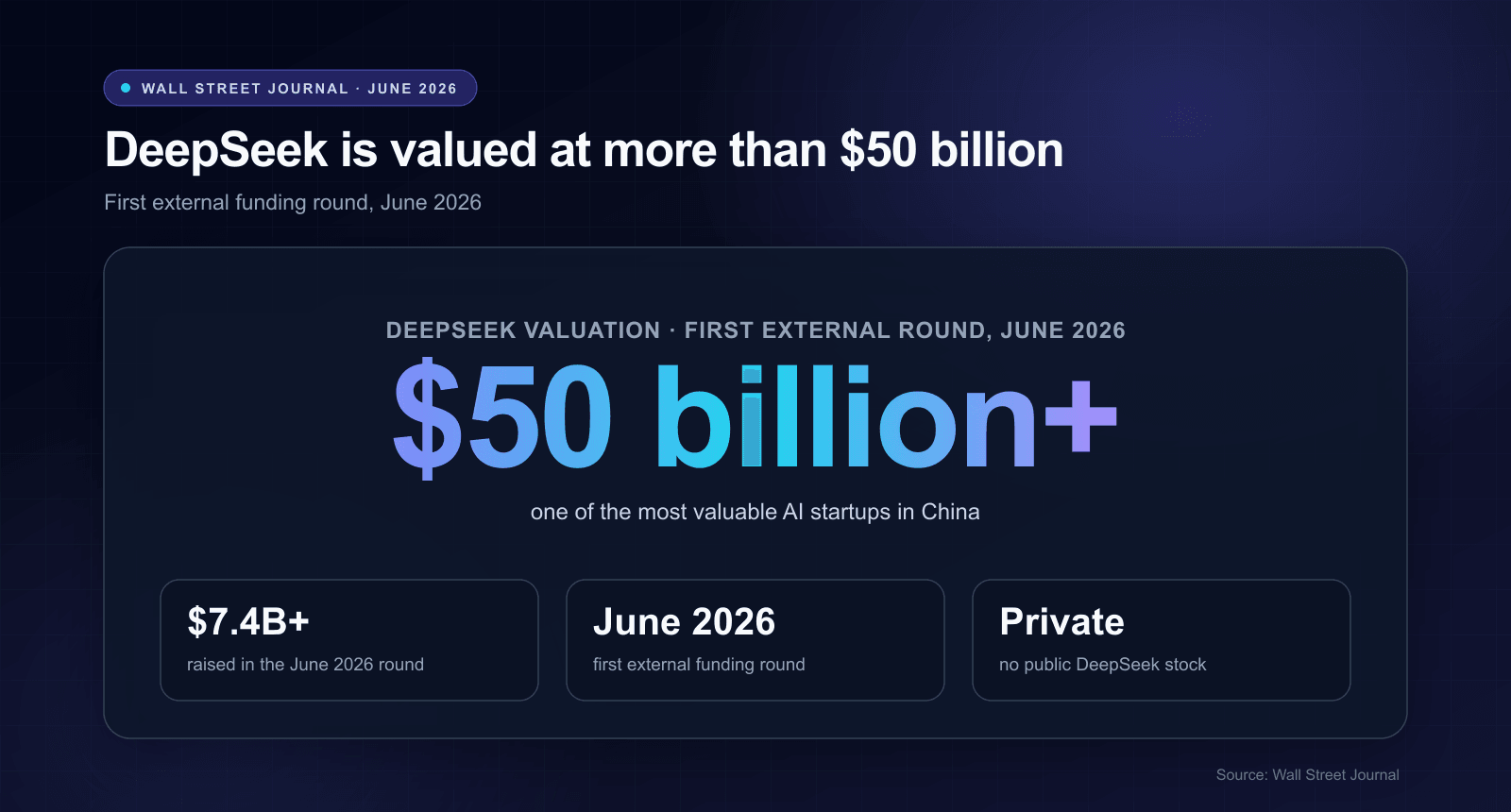
- DeepSeek raised more than $7.4 billion in the first external fundraising round in June 2026, with a valuation of more than $50 billion (Wall Street Journal).
Is DeepSeek better than ChatGPT?
There is no single winner. DeepSeek and ChatGPT lead on different dimensions, so the honest answer depends on what you are optimizing for.
| Dimension | DeepSeek | ChatGPT |
|---|---|---|
| Model access | Open source; MIT-licensed releases you can self-host | Closed source models through ChatGPT and the OpenAI API |
| Flagship model | DeepSeek-V4-Pro | GPT-5.6 Sol |
| API price | Among the cheapest frontier LLMs | Premium pricing for flagship models |
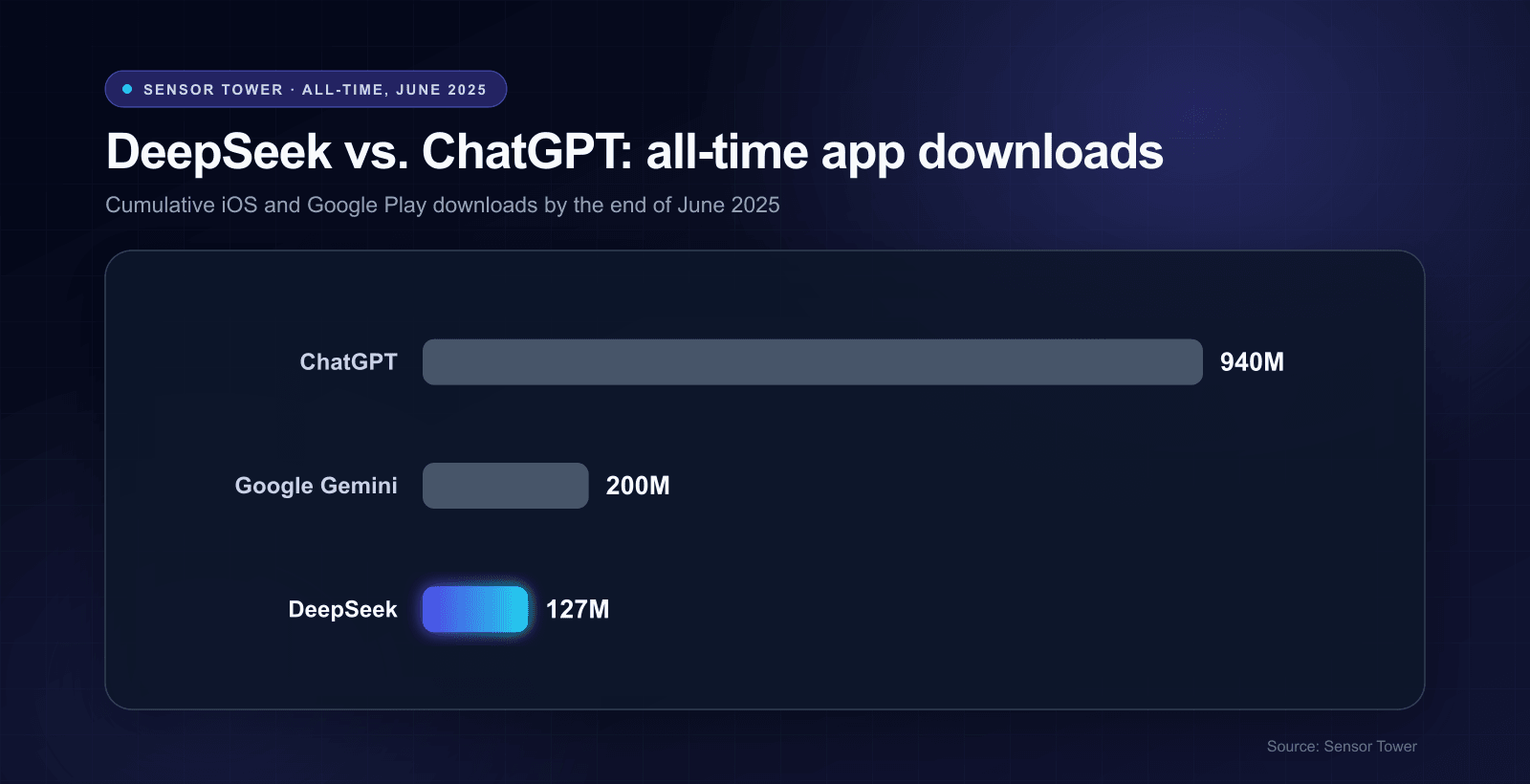
| Consumer reach | 127 million all-time iOS and Google Play downloads by the end of June 2025 | 940 million all-time iOS and Google Play downloads by the end of June 2025 |
On quality, the two are very close on many frontier benchmarks, with GPT-5.5 holding a slight edge in some agentic and graduate-level reasoning tasks, while DeepSeek-V4-Pro delivers unusually strong results for coding, math, and cost.
The bigger difference is infrastructure control. Teams can self-host DeepSeek on their own infrastructure, choose the inference engine, and tune the serving stack for the workload. That means they can use techniques such as prefix-aware routing, custom batching, quantization, and prefill-decode disaggregation to reduce cost, increase throughput, or lower latency for a specific traffic pattern.
That is not how ChatGPT or the OpenAI API works. When you call a hosted proprietary API, you get the model quality and platform reliability, but you do not control the scheduler, kernel stack, cache policy, GPU topology, batching strategy, or model placement. Rate limits, queueing behavior, model snapshots, and performance characteristics are managed by the provider, so production behavior is less controllable than a self-hosted deployment.
Fine-tuning is different too. OpenAI offers model optimization and fine-tuning workflows for selected API models. However, teams cannot take ChatGPT itself, run the full model inside their own environment, and train it on enterprise domain data under private infrastructure controls. With an open source DeepSeek model, teams with strict data-boundary requirements can keep domain-specific data inside their own environment, fine-tune or adapt the model there, and deploy the tuned model behind their own access controls.
How many users does DeepSeek have?
DeepSeek does not disclose official global monthly active users, so the most useful public user data comes from third-party trackers.
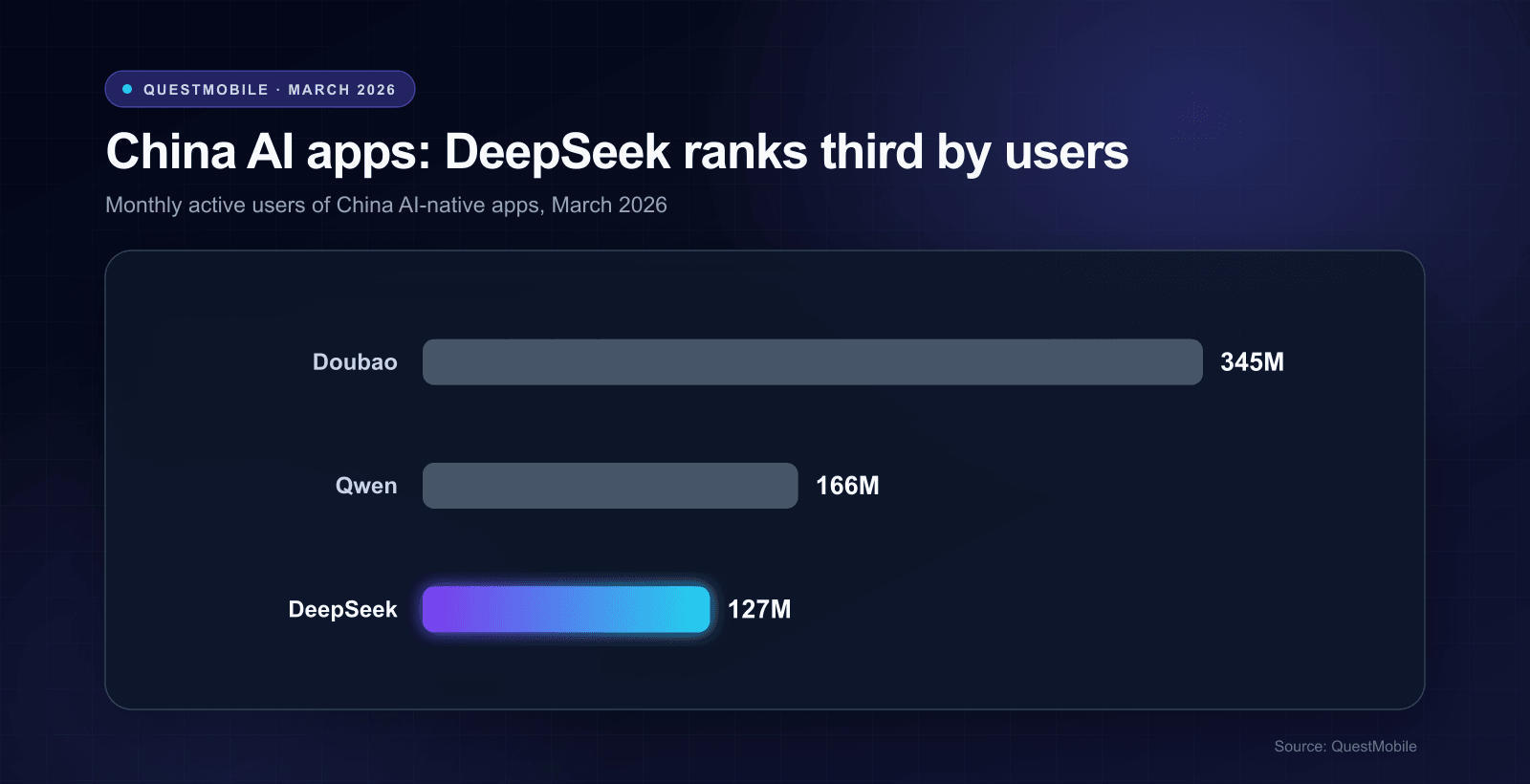
QuestMobile reported that China AI-native apps reached 446 million monthly active users in March 2026, up 134.95 million from November 2025, a 43.4% increase. DeepSeek ranked third in that category with 127 million monthly active users, behind Doubao from ByteDance at 345 million and Qwen from Alibaba at 166 million.
| User metric | Value | What to know |
|---|---|---|
| China AI-native app MAU | 446 million | March 2026, up 134.95 million from November 2025 |
| DeepSeek China MAU | 127 million | March 2026, No. 3 among China AI-native apps |
| Doubao China MAU | 345 million | March 2026, No. 1 among China AI-native apps |
| Qwen China MAU | 166 million | March 2026, No. 2 among China AI-native apps |
| DeepSeek average active rate | 21.0% | Q1 2026 |
| DeepSeek monthly usage frequency | 41.7 times per user | Q1 2026, No. 2 among apps named in the report |
The three leading AI-native apps had rising user stickiness during Q1 2026. The average active rates for the quarter were 33.5% for Doubao, 17.1% for Qwen, and 21.0% for DeepSeek.
DeepSeek ranked second by monthly usage frequency among the apps named in the report. Users opened or used DeepSeek 41.7 times per month in Q1 2026, behind Doubao at 54.8 times.
Source: QuestMobile
DeepSeek Hugging Face downloads
Hugging Face downloads show developer interest rather than consumer usage.
| DeepSeek models | Downloads by July 2026 |
|---|---|
| DeepSeek-V3 | 1 million+ |
| DeepSeek-R1 | 8.5 million+ |
| DeepSeek-V3.1 | 27.9K+ |
| DeepSeek-V3.2 | 1.8 million+ |
| DeepSeek-V4-Flash plus DeepSeek-V4-Pro | 3.5 million+ |
Source: Hugging Face
DeepSeek Harness GitHub stars
The fastest DeepSeek growth story of 2026 is not a model. It is a developer tool.
DeepSeek open sourced DeepSeek Harness, an MIT-licensed agent harness, on August 13, 2026, alongside the DeepSeek-V4-Pro-0813 release. The repository became the fastest-growing open source project GitHub has recorded.
| DeepSeek Harness milestone | Stars |
|---|---|
| First 1.5 hours | 22,000+ |
| First 12 hours | 50,000+ |
| First 48 hours | 100,000+ |
For scale, the previous velocity record holder, OpenClaw, took 84 days to reach 200,000 stars.
The tool itself is a plugin architecture where models, tools, skills, sessions, sandboxes, storage, loops, and the UI are all swappable plugins. It ships four modes, including a minimal mode that DeepSeek used to produce the published code-agent benchmark scores for V4-Pro-0813.
Source: GitHub
DeepSeek app downloads and rankings
The DeepSeek app had one of the fastest launches in consumer AI. By Monday morning after the launch-weekend surge, the app had reached 2.6 million downloads across iOS and Google Play.
The ranking story was even sharper. On iOS, DeepSeek became the No. 1 free app in the U.S. App Store and 51 other countries in January 2025. The app also reached the No. 1 position on the U.S. Google Play Store the next day.
By the end of June 2025, Sensor Tower reported 127 million all-time downloads for DeepSeek across iOS and Google Play. ChatGPT had 940 million all-time downloads at the same point, while Google Gemini had 200 million.
| App | All-time downloads by end of June 2025 |
|---|---|
| ChatGPT | 940 million |
| Google Gemini | 200 million |
| DeepSeek | 127 million |
DeepSeek adoption is strongest in Asia, especially China. It had more downloads than any other generative AI app during the first six months after launch, helped by strength in Asia, the Middle East, and Africa.
Sources: TechCrunch, Sensor Tower
DeepSeek usage on OpenRouter
OpenRouter is a unified API platform that routes requests across many model providers. The OpenRouter study analyzed more than 100 trillion tokens from November 2024 through November 2025.
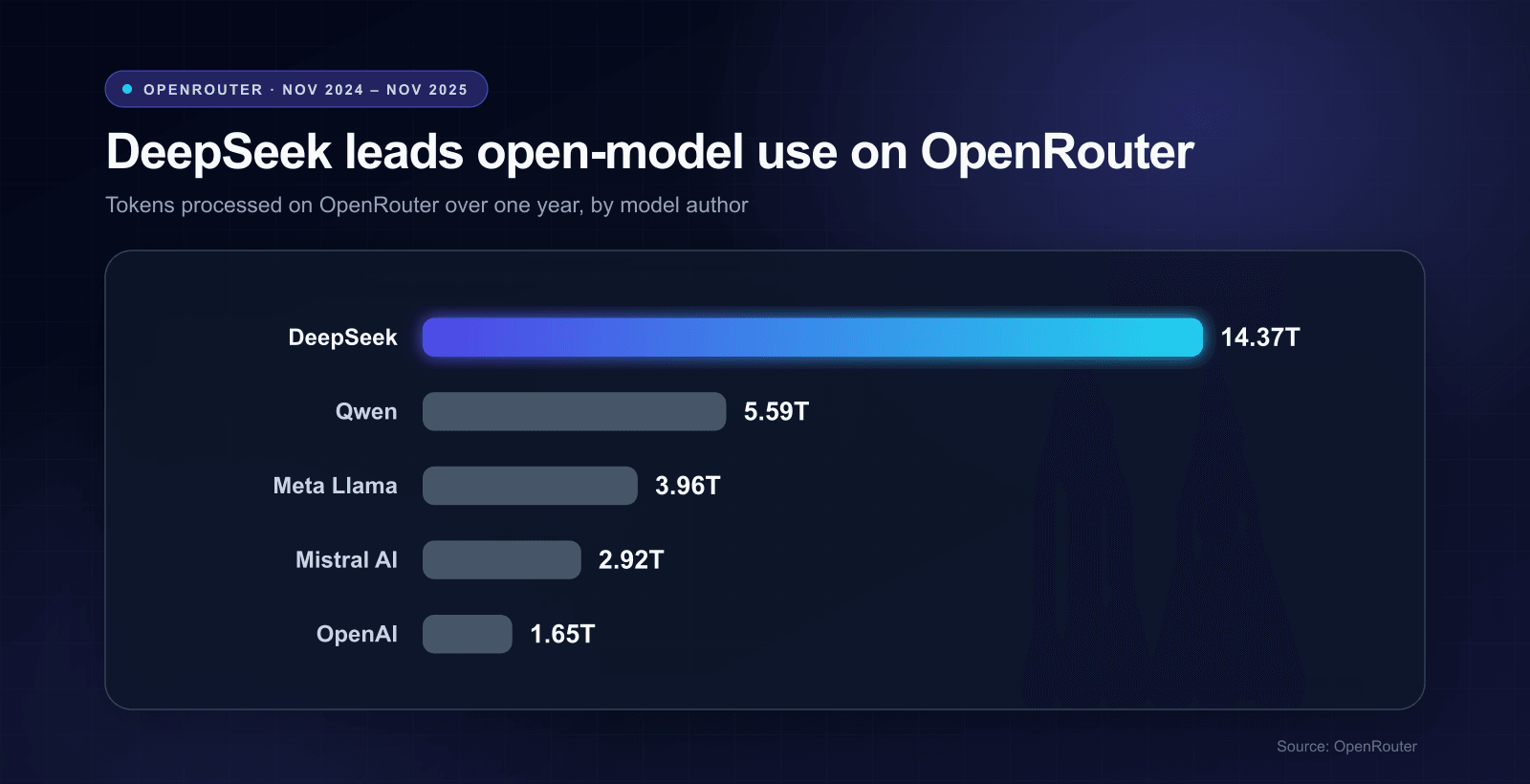
DeepSeek was the largest open model family in that dataset:
| Model author | Tokens processed on OpenRouter |
|---|---|
| DeepSeek | 14.37 trillion |
| Qwen | 5.59 trillion |
| Meta Llama | 3.96 trillion |
| Mistral AI | 2.92 trillion |
| OpenAI | 1.65 trillion |
| MiniMax | 1.26 trillion |
| Z.ai | 1.18 trillion |
| TNGTech | 1.13 trillion |
| Moonshot AI | 0.92 trillion |
| 0.82 trillion |
DeepSeek processed about 2.6 times as many OpenRouter tokens as Qwen, the second-largest open model family in the study.
The same study found that open source models reached approximately one-third of total OpenRouter token usage by late 2025. For the broader ecosystem picture, see my 30+ open source LLM statistics.
Source: OpenRouter
How much did DeepSeek-V3 cost to train?
DeepSeek reported 2.788 million H800 GPU-hours and $5.576 million for the official training of DeepSeek-V3, assuming an H800 rental price of $2 per GPU-hour.
The number that became famous in headlines mostly refers to the model training run, not the full cost of building DeepSeek as a company.
| DeepSeek-V3 training stage | H800 GPU-hours | Reported cost |
|---|---|---|
| Pre-training | 2.664 million | $5.328 million |
| Context extension | 119,000 | $238,000 |
| Post-training | 5,000 | $10,000 |
| Total | 2.788 million | $5.576 million |
The caveat matters. The DeepSeek-V3 report says these costs include only the official training of DeepSeek-V3 and exclude prior research, ablation experiments, architecture work, algorithms, and data. The $5.576 million figure is real, but it is not an all-in company build cost.
Source: DeepSeek-V3 Technical Report
DeepSeek API pricing
DeepSeek is one of the cheapest ways to access a frontier-scale open model through an API.
Prices rose sharply on August 16, 2026. At 16:00 UTC that day, alongside the official DeepSeek-V4-Pro-0813 release, DeepSeek retired the flat rate and moved to a peak and off-peak structure. Peak hours are 01:00 to 04:00 and 06:00 to 10:00 UTC, Monday through Friday. Every other hour is off-peak, at half the peak rate. DeepSeek narrowed the peak windows again on August 23, 2026, when it dropped weekend peak pricing: Saturdays and Sundays are now off-peak around the clock.
| Model | Cached input, per 1M tokens | Cache-miss input, per 1M tokens | Output, per 1M tokens |
|---|---|---|---|
| DeepSeek-V4-Flash, off-peak | $0.007 | $0.22 | $0.66 |
| DeepSeek-V4-Flash, peak | $0.014 | $0.44 | $1.32 |
| DeepSeek-V4-Pro, off-peak | $0.022 | $0.66 | $1.98 |
| DeepSeek-V4-Pro, peak | $0.044 | $1.32 | $3.96 |
| GPT-5.6 Luna | $0.02 | $0.20 | $1.20 |
| GPT-5.6 Sol | $0.40 | $4.00 | $20.00 |
The increase is steep. V4-Pro output went from $0.87 per million tokens to $3.96 at peak, so even the off-peak rate of $1.98 is more than double the old flat price. V4-Flash went from $0.28 to $1.32 at peak and $0.66 off-peak. Measured on cached input, the largest of these increases runs above 1,100%.
Against the OpenAI flagship the advantage survives, though it narrowed from the other direction. OpenAI cut GPT-5.6 Sol on August 21, 2026, from $5.00 to $4.00 per million input tokens and from $30.00 to $20.00 per million output tokens, a promotional rate OpenAI has committed to at least through November 21, 2026. On cache-miss input and output, off-peak V4-Flash is now about 94.5% cheaper on input and 96.7% cheaper on output than Sol. At peak those become 89.0% and 93.4%.
Against the small end of the OpenAI lineup the advantage is gone. GPT-5.6 Luna lists at $0.20 per million input tokens and $1.20 per million output tokens. Off-peak V4-Flash input now costs 10% more than Luna, and output is only 45% cheaper. At peak, V4-Flash is more expensive than Luna on both input and output. Before August 16 the same comparison had V4-Flash 30% cheaper on input and 76.7% cheaper on output.
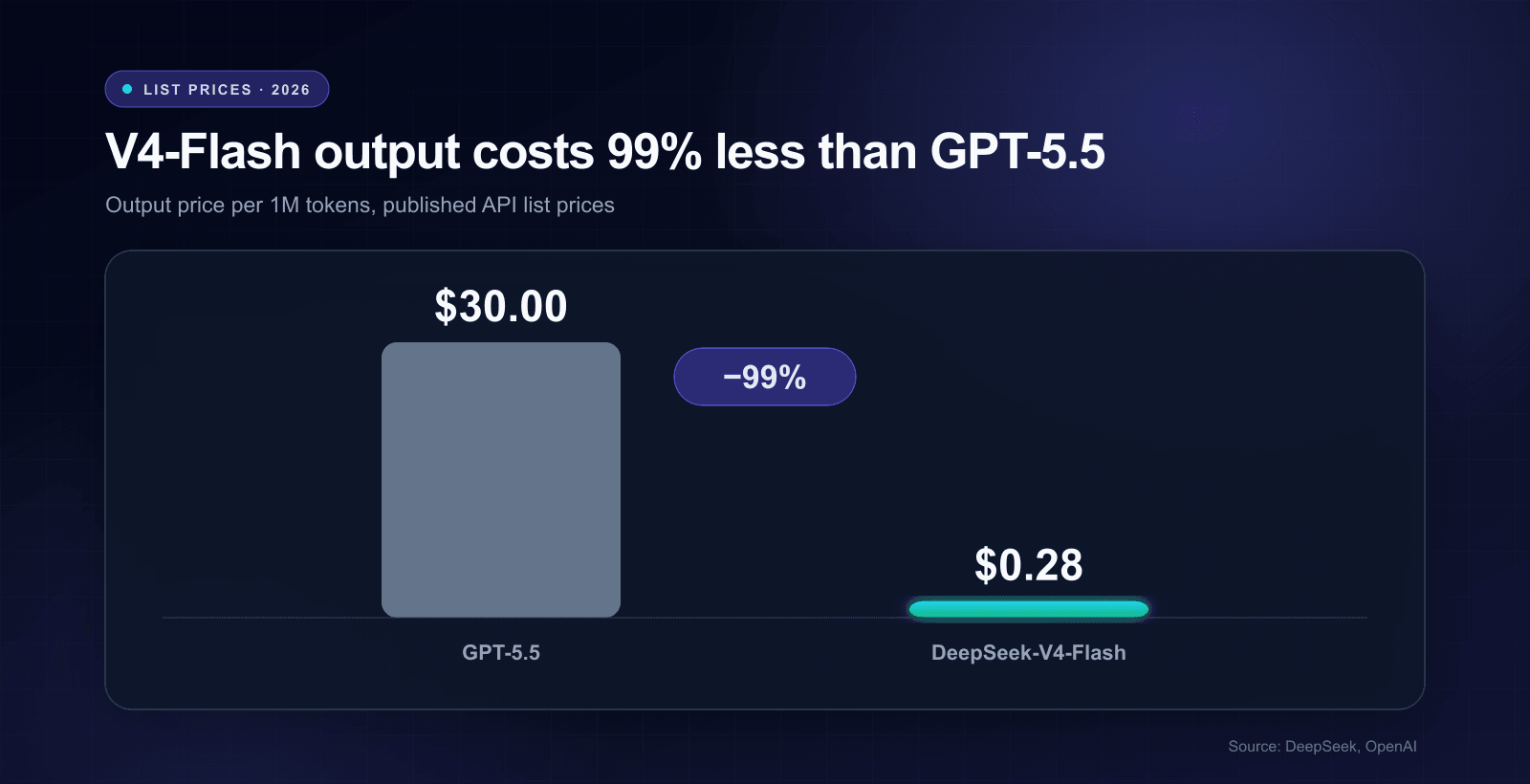
DeepSeek said the change is meant to allocate resources more reasonably, and the tiered structure is designed to shift workloads toward less congested hours. The table above reflects the rates published for August 16, 2026.
That pricing gap is one reason DeepSeek spread quickly among cost-sensitive developers. Serving cost is not only about API list price, though. Latency, rate limits, context length, output quality, data policy, and reliability also matter. OpenLLMStack tracks the serving techniques behind lower costs on the inference optimizations page.
Sources: DeepSeek API docs, OpenAI API pricing
DeepSeek company valuation and funding
DeepSeek raised more than $7.4 billion in a first external fundraising round in June 2026. Investors valued the company at more than $50 billion, making DeepSeek one of the most valuable AI startups in China.
Only weeks later, the Financial Times reported that DeepSeek had already opened preliminary talks with investors on a second round at a valuation of about $71 billion, roughly 37% above the first round. The reported driver is the capital needed to build out data centers and buy more AI chips, as the shift toward AI agents pushes compute requirements sharply higher.
Bloomberg reported the same week that DeepSeek is also preparing an IPO filing in mainland China this year, which would set up a listing in 2027.
Source: Wall Street Journal, Bloomberg
How many employees does DeepSeek have?
DeepSeek has not published a current official headcount. Public company profiles and earlier reporting put the team at roughly 160 employees in 2025, but that number is now probably stale.
After the 2026 funding round, DeepSeek started hiring for 27 types of technical and functional roles, including development engineers, data engineers, AI product managers, operations staff, HR, legal, and finance, according to the Wall Street Journal. The company said the hiring push was part of a plan to double the workforce.
That makes the best current answer: DeepSeek was a small research-heavy team in 2025, and the company began scaling aggressively after the June 2026 funding round.
Source: Wall Street Journal
DeepSeek and the NVIDIA market shock
On January 27, 2025, NVIDIA lost about $589 billion in market value in a single day after the DeepSeek launch shook confidence in the high-cost AI infrastructure narrative. Bloomberg data cited by the NY Post described the drop as the largest single-day company decline in U.S. stock market history at the time.
The sell-off did not mean demand for AI chips disappeared. It showed that investors were suddenly forced to price in a more efficient model-development path. DeepSeek had demonstrated that competitive open models could be trained and served with far less compute than many investors expected.
You can trace this and other milestones on the OpenLLMStack timeline.
Source: Bloomberg via NY Post
What is the latest DeepSeek model?
As of August 13, 2026, the newest DeepSeek release is DeepSeek-V4-Pro-0813, the official version of the V4-Pro flagship. It went live on the API on August 12 and took over the deepseek-v4-pro model name from the April preview, so no calling code had to change. DeepSeek published the release notes the following day.
The architecture did not change. V4-Pro-0813 keeps the 1.6T total parameters, 49B active parameters, and 1M-token context window of the preview. As with the V4-Flash-0731 release two weeks earlier, DeepSeek redid post-training only, and nearly all the reported gains landed on agent tasks.
| Agent benchmark | V4-Pro-0813 | V4-Pro Preview | V4-Flash-0731 |
|---|---|---|---|
| Terminal Bench 2.1 | 87.9 | 72.1 | 82.7 |
| Cybergym | 83.3 | 52.7 | 76.7 |
| Toolathlon verified | 74.1 | 55.9 | 70.3 |
| DSBench-FullStack | 71.1 | 41.8 | 68.7 |
| DSBench-Hard | 67.2 | 31.1 | 59.6 |
| DeepSWE | 62.7 | 12.8 | 54.4 |
| NL2Repo | 61.5 | 38.5 | 54.2 |
| Agent Last Exam | 25.7 | 16.5 | 25.2 |
This release reverses the pattern from July. When V4-Flash-0731 shipped, the cheap model beat the preview of the expensive one on every agent benchmark DeepSeek published, which made post-training look like the dominant lever. The comparison was never quite fair, because it set a freshly trained build against a three-month-old preview. With both models now on official builds, the ordering is conventional again: V4-Pro-0813 leads V4-Flash-0731 on all eleven benchmarks DeepSeek reported. The margins are modest, though, at 87.9 against 82.7 on Terminal Bench 2.1 and 62.7 against 54.4 on DeepSWE, while V4-Pro costs three times more per output token.
One caveat on reading these numbers: for the code-agent tasks, DeepSeek evaluated V4-Pro-0813 inside DeepSeek Harness in minimal mode, a two-tool setup limited to bash and a text editor, at max reasoning effort. The scores measure the model plus that scaffold. DeepSeek open-sourced the harness under the MIT license alongside the model.
The second change is integration. V4-Pro-0813 natively supports the Responses API format with a one-click Codex setup, matching what V4-Flash-0731 shipped in July. Codex is the OpenAI coding assistant that ships as a command-line tool, a ChatGPT desktop app, and a VS Code extension.
Sources: DeepSeek release notes, DeepSeek-V4-Pro-0813 model card
How the official V4 builds score on independent benchmarks
Every score in the table above comes from DeepSeek. Independent evaluators have now tested both official builds.
Artificial Analysis scores DeepSeek-V4-Pro-0813 at 53 on the Intelligence Index v4.1.1, the version that combines nine evaluations including GDPval-AA v2, Terminal-Bench v2.1, SciCode, Humanity’s Last Exam, and GPQA Diamond. Every figure below comes from the same v4.1.1 run, so the models are directly comparable.
| Model | Artificial Analysis Intelligence Index v4.1.1 |
|---|---|
| Claude Opus 5 (max) | 63 |
| Kimi K3 (max) | 60 |
| Qwen3.8 Max | 58 |
| DeepSeek-V4-Pro-0813 (max) | 53 |
| GLM-5.2 (max) | 53 |
| GPT-5.6 Luna (max) | 52 |
| DeepSeek-V4-Flash-0731 (max) | 52 |
| MiniMax-M3 | 45 |
| DeepSeek-V4-Pro, April (max) | 45 |
The 0813 build moves the flagship from 45 to 53 and back above V4-Flash-0731, which is what you would expect from a model roughly five times larger. The margin is thin, though, at one point. DeepSeek does not lead the open field either: Kimi K3 at 60 and Qwen3.8 Max at 58 are both open weights and both score higher.
The cost panel is the stronger result. Plotted against cost per task, V4-Pro-0813 lands inside the most attractive quadrant on the Artificial Analysis Pareto line at roughly $0.25 per task. Claude Opus 5 and Claude Fable 5 score about 10 points higher and cost close to ten times more per task. Artificial Analysis also flags V4-Pro-0813 as somewhat verbose, at 130 million output tokens across the evaluation suite against a median of 100 million.
Two findings about V4-Flash-0731 matter beyond the headline score:
- It got less verbose. V4-Flash-0731 completed the evaluation suite using roughly 206 million output tokens, down from 234 million for the previous build, about 12% fewer. Cheaper per token and fewer tokens compound.
- Throughput is mid-pack. Output runs at 122.7 tokens per second with a 1.34 second time to first token, ranking ninth of 101 on speed.
Every cost-per-task figure above predates the August 16 price increase. Treat any DeepSeek cost-per-task comparison published before that date as roughly 4.7x too cheap.
Two other independent evaluations line up. On the Vals Index open-weights view, V4-Pro-0813 ranks second at 66.25% accuracy at $0.14 per test, behind Kimi K3 at 74.70% and ahead of Qwen 3.8 Max at 65.47% and GLM 5.2 at 65.02%. V4-Flash-0731 is fifth at 63.95%, at $0.06 per test. On the Arena Code Arena WebDev board, DeepSeek-V4-Pro (Max) scores 1,607, above every Claude Opus 4.x entry in the top 15, with DeepSeek V4 Flash (High) at 1,582.
For the full benchmark sets and pricing, see the DeepSeek-V4-Pro-0813 and DeepSeek-V4-Flash-0731 model pages.
Sources: Artificial Analysis, Vals AI, Arena
DeepSeek model release timeline
DeepSeek moved from efficient MoE models to open reasoning models and then million-token-context V4 models in less than two years.
| Model | Released | Notable for |
|---|---|---|
| DeepSeek-V3 | December 2024 | 671B-parameter MoE; $5.576M reported official training cost |
| DeepSeek-R1 | January 2025 | Open reasoning model; launch that pushed the app to No. 1 |
| DeepSeek-V3.1 | August 2025 | Hybrid thinking and non-thinking mode |
| DeepSeek-V3.2 | December 2025 | Long-context and serving-efficiency updates |
| DeepSeek-V4-Flash | April 2026 | 284B total parameters, 13B active, 1M context |
| DeepSeek-V4-Pro | April 2026 | 1.6T total parameters, 49B active, 1M context |
| DeepSeek-V4-Flash-0731 | July 2026 | First official V4 build; agent-focused post-training, native Responses API and Codex support |
| DeepSeek-V4-Pro-0813 | August 2026 | Official V4-Pro build; agent-focused post-training, DSpark speculative decoding, released with the open-source DeepSeek Harness and a large API price increase |
You can see current specs, context windows, and recommended hardware for open models on the OpenLLMStack models page. To see how the V4 line compares against other models, see the best open source LLMs in 2026.
Frequently asked questions
Is DeepSeek free?
The DeepSeek chat app and website have a free consumer tier. API access is paid per token, and since August 16, 2026 the rate depends on the hour. Off-peak, DeepSeek-V4-Flash costs $0.22 per million cache-miss input tokens and $0.66 per million output tokens. At peak, 01:00 to 04:00 and 06:00 to 10:00 UTC on weekdays, both figures double to $0.44 and $1.32. Weekends have been off-peak all day since August 23, 2026. You can also self-host open source DeepSeek models freely on your device with tools like Ollama and vLLM.
Can you use DeepSeek with Codex?
Yes, with both official V4 builds. DeepSeek-V4-Flash-0731, released July 31, 2026, and DeepSeek-V4-Pro-0813, released August 12, 2026, natively support the Responses API format and were adapted specifically for Codex, the OpenAI coding assistant that covers a command-line tool, the ChatGPT desktop app, and a VS Code extension. The DeepSeek API is also used as a backend by other coding agents, including Claude Code and GitHub Copilot. DeepSeek additionally ships an agent harness of its own, DeepSeek Harness, open sourced under the MIT license in August 2026.
Who owns DeepSeek?
DeepSeek is a Chinese AI company connected to High-Flyer, the quantitative hedge fund founded by Liang Wenfeng. After the first external funding round in June 2026, investors valued DeepSeek at more than $50 billion.
Can DeepSeek generate images?
No. The flagship DeepSeek chat and reasoning models focus on text, code, and reasoning. DeepSeek has also released separate multimodal research models, but the main DeepSeek-V4 chat models are not positioned as image generators.
How much did DeepSeek cost to train?
DeepSeek reported $5.576 million for the official DeepSeek-V3 training process, based on 2.788 million H800 GPU-hours at $2 per GPU-hour. That excludes prior research, ablation experiments, architecture work, algorithms, and data.
How to run DeepSeek locally
DeepSeek open source models can run with inference engines such as vLLM, SGLang, Ollama, and llama.cpp, depending on the specific model size and quantization. Smaller distilled models can run on a single high-end GPU or strong local machine, while full V4 models require serious multi-GPU infrastructure. See the OpenLLMStack inference engines and models pages for deployment options.
How to invest in DeepSeek
You cannot buy public DeepSeek stock. DeepSeek is a private company. Some investors seek indirect exposure through public AI infrastructure, semiconductor, cloud, or China technology companies, but that is not the same as owning DeepSeek equity.
Conclusion
DeepSeek is the clearest example of how open source models changed the AI cost debate. The app reached No. 1 in the U.S. App Store, DeepSeek models led open model usage on OpenRouter, and the DeepSeek-V3 training report made every AI investor revisit assumptions about compute cost.
Is DeepSeek better than ChatGPT? For price, open weights, and control, often yes. For global reach and ecosystem, no. The useful answer is not a brand verdict; it is a workload decision.